“The masters of the universe, it turns out, are losers.
The Brett Kavanaugh hearing was a kaleidoscope of family and God and prestigious clerkships spliced with boofing and ralphing and brewskis. It was a thorough dressing-down. In the end, one was left with the impression of an unremarkable guy who was born on a conveyor belt to power, without much obligation to distinguish himself from his peers. On the contrary, his success was relatively guaranteed on the condition that he didn’t distinguish himself from them, that he simply play nice with the fellas — and not necessarily so nice with women — from prep school to the Ivy League to the White House and beyond.
What struck me most about yesterday’s hearing, cutting through Kavanaugh’s tone-deaf retorts and indignant whinging and his frequent professions of love for beer, is how utterly ordinary he is. This guy is juvenile, arrogant, sexist — and very familiar. It pointed to a larger truth: the people running the show are callous and dangerous, but they’re also astonishingly average. They have no irreplaceable qualities or insights that would oblige us to put up with their bullshit. They would hate for us to realize this.”
Monday, October 1, 2018
The Banality of Brett Kavanaugh 14

Thursday, August 30, 2018
socialistexan: fullhalalalchemist: bonkai-diaries: Bruh many... 14
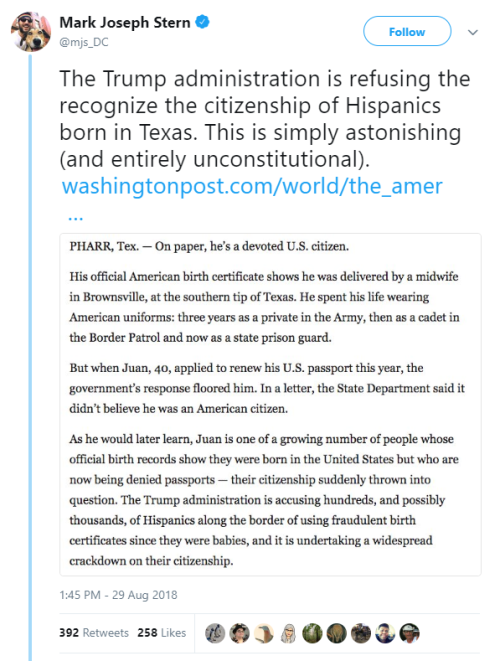
many people have been saying since the beginning he is going to come after citizens. First he came for undocumented, then for green card holders, and now for actual citizens. This doesn’t end with just that.
This is the guy that started his (latest) Presidential run by launching an entire investigation into Barack Obama’s birth certificate.
Donny has been showing his hand on this since 2013.
Friday, August 3, 2018
Saudi Arabia Planned to Invade Qatar Last Summer. Rex Tillerson’s Efforts to Stop It May Have Cost Him His Job. 14
Thirteen hours before Secretary of State Rex Tillerson learned from the presidential Twitter feed that he was being fired, he did something that President Donald Trump had been unwilling to do. Following a phone call with his British counterpart, Tillerson condemned a deadly nerve agent attack in the U.K., saying that he had “full confidence in the U.K.’s investigation and its assessment that Russia was likely responsible.”
White House Press Secretary Sarah Sanders had called the attack “reckless, indiscriminate, and irresponsible,” but stopped short of blaming Russia, leading numerous media outlets to speculate that Tillerson was fired for criticizing Russia.
But in the months that followed his departure, press reports strongly suggested that the countries lobbying hardest for Tillerson’s removal were Saudi Arabia and the United Arab Emirates, both of which were frustrated by Tillerson’s attempts to mediate and end their blockade of Qatar. One report in the New York Times even suggested that the UAE ambassador to Washington knew that Tillerson would be forced out three months before he was fired in March.
The Intercept has learned of a previously unreported episode that stoked the UAE and Saudi Arabia’s anger at Tillerson and that may have played a key role in his removal. In the summer of 2017, several months before the Gulf allies started pushing for his ouster, Tillerson intervened to stop a secret Saudi-led, UAE-backed plan to invade and essentially conquer Qatar, according to one current member of the U.S. intelligence community and two former State Department officials, all of whom declined to be named, citing the sensitivity of the matter.
In the days and weeks after Saudi Arabia, the UAE, Egypt, and Bahrain cut diplomatic ties with Qatar and closed down their land, sea, and air borders with the country, Tillerson made a series of phone calls urging Saudi officials not to take military action against the country. The flurry of calls in June 2017 has been reported, but State Department and press accounts at the time described them as part of a broad-strokes effort to resolve tensions in the Gulf, not as an attempt by Tillerson to avert a Saudi-led military operation.
In the calls, Tillerson, who dealt extensively with the Qatari government as the CEO of Exxon Mobil, urged Saudi King Salman, then-Deputy Crown Prince Mohammed bin Salman, and Foreign Minister Adel al-Jubeir not to attack Qatar or otherwise escalate hostilities, the sources told The Intercept. Tillerson also encouraged Defense Secretary Jim Mattis to call his counterparts in Saudi Arabia to explain the dangers of such an invasion. Al Udeid Air Base near Doha, Qatar’s capital city, is the forward headquarters of U.S. Central Command and home to some 10,000 American troops.
Pressure from Tillerson caused Mohammed bin Salman, the de facto ruler of the country, to back down, concerned that the invasion would damage Saudi Arabia’s long-term relationship with the U.S. But Tillerson’s intervention enraged Mohammed bin Zayed, the crown prince of Abu Dhabi and effective ruler of that country, according to the U.S. intelligence official and a source close to the Emirati royal family, who declined to be identified, citing concerns about his safety.
Later that June, Mohammed bin Salman would be named crown prince, leapfrogging over his cousin to become next in line for the throne after his elderly father. His ascension signaled his growing influence over the kingdom’s affairs.
Qatari intelligence agents working inside Saudi Arabia discovered the plan in the early summer of 2017, according to the U.S. intelligence official. Tillerson acted after the Qatari government notified him and the U.S. embassy in Doha. Several months later, intelligence reporting by the U.S. and U.K. confirmed the existence of the plan.
The plan, which was largely devised by the Saudi and UAE crown princes and was likely some weeks away from being implemented, involved Saudi ground troops crossing the land border into Qatar, and, with military support from the UAE, advancing roughly 70 miles toward Doha. Circumventing the U.S. air base, Saudi forces would then seize the capital.
On June 20, State Department spokesperson Heather Nauert told reporters that Tillerson had “more than 20 calls and meetings with Gulf and other regional and intermediate actors,” including three phone calls and two meetings with Jubeir. “The more time goes by, the more doubt is raised about the actions taken by Saudi Arabia and the UAE,” she said….
According to one news report, Tillerson was frustrated with the White House for undercutting him, and his aides suspected that the line in Trump’s prepared Rose Garden remarks had been written by UAE Ambassador Yousef Al Otaiba, a powerful D.C. player who maintained “almost constant phone and email contact” with Trump’s son-in-law Jared Kushner, according to Politico.
At the time, Kushner was personally handling much of the administration’s diplomacy with the Gulf states, and the leaders of Saudi Arabia and the UAE were choosing to go through him instead of the U.S. defense or intelligence establishments. Kushner communicated directly with the crown princes of Saudi Arabia and the UAE using the encrypted messaging service WhatsApp.
Some Gulf watchers speculate that the incentive for the planned invasion may have been partly financial. Saudi Arabia’s “cradle to grave” welfare system relies on high oil prices, which plummeted in 2014 and have not fully recovered. Since the current king came to power in 2015, the country has spent more than a third of its $737 billion in reserves, and last year, the Saudi economy entered a painful recession. In response, the government has looked for ways to raise money, including by selling shares in the state-owned oil company, Saudi Aramco.
“It’s unsustainable,” said Bruce Riedel, a senior fellow at the Brookings Institute and 30-year CIA officer, in a lecture last November. “In the three years since [King Salman] ascended to the throne, one third of Saudi Arabia’s reserves have already been spent. You don’t need to have an MBA from the Wharton school to figure out what that means six years from now.”
If the Saudis had succeeded in seizing Doha, they would potentially have been able to gain access to the country’s $320 billion sovereign wealth fund. In November of last year, months after the plan collapsed, the Saudi crown prince rounded up and detained dozens of his relatives in the Ritz-Carlton Riyadh, forcing them to sign over billions in privately held assets. The government justified the detentions as a corruption crackdown, but it allowed the state to recoup billions in assets for government use.
Beginning in the fall of 2017, the crown princes in Riyadh and Abu Dhabi began lobbying the White House for Tillerson’s removal, according to the source close to the Emirati royal family and another source who is close to the Saudi royal family.
american-gulf collusion is of course bipartisan and doesn’t merit any investigation
Saturday, September 23, 2017
afatblackfairy: wetheurban: HOW TO HELP TORTURED GAY MEN IN... 14


HOW TO HELP TORTURED GAY MEN IN CHECHNYA
We can’t allow this to continue. A petition has also been launched by change.org and signed by tens of thousands of people.
It demands a full investigation of all the facts and unlawful repression in Chechnya of the LGBT population and calls for punishment for the ‘guilty parties’ and the end to the practice of extra-judicial violence.
You can sign that here.
Can y'all share this please???
Sunday, September 3, 2017
lesbiantoccataandfugue: During the United States Red Scare after the end of World War II, the term... 14
During the United States Red Scare after the end of World War II, the term “premature anti-fascist” came into currency to describe Americans who had strongly agitated or worked against fascism, such as by fighting for the Republicans in the Spanish Civil War, before fascism was seen as a proximate and existential threat to the United States. The implication was that such persons were Communists or Communist sympathizers whose loyalty to the United States was suspect.
there’s nothing new under the sun
Saturday, July 1, 2017
enoughtohold: kaijutegu: homologg: I’ve been thinking about... 14

I’ve been thinking about this all morning
I want everyone in America to read this page
Here’s a transcription (for text-to-speech, font changing, translation, whatever):
The discovery of cyanide in Tylenol capsules occurred in those same weeks of October 1982. The existence of the poisoned capsules, all found in the Chicago area, was first reported on October 1. The New York Times wrote a story on the Tylenol scare every day for the entire month of October and produced twenty-three more pieces in the two months after that. Four of the stories appeared on the front page The poisoning received comparable coverage in media across the country, inspiring an immense government effort. Within days of the discovery of what proved to be the only cyanide-laced capsules, the Food and Drug Administration issued orders removing the drug from store shelves across the country. Federal, state, and local authorities were immediately on hand to coordinate efforts in states thousands of miles from where the tampered boxes appeared. No action was too extreme and no expense too great, they insisted, to save lives.
Investigators poured into Chicago to crack the mystery. More than 100 state, federal, and local agents worked the Illinois end of the case alone, filling twenty-six volumes with 11,500 pages of probe reports. The Food and Drug Administration had more than 1,100 employees testing 1.5 million similar capsules for evidence of poisoning, and chasing down every faint possibility of a victim of the new terror, according to the breathless news reports of the time. Tylenol’s parent company, Johnson & Johnson, estimated spending $100 million in the effort. Within five weeks, the U.S. Department of Health and Human Services issued new regulations on tamper-resistant packaging to avert repetition of such a tragedy.
In the end, the millions of dollars for CDC Tylenol investigations yielded little beyond the probability that some lone crackpot had tampered with a few boxes of the pain reliever. NO more cases of poisoning occurred beyond the first handful reported in early October. Yet the crisis showed how the government could spring into action, issue warnings, change regulations, and spend money, lots of money, when they thought the lives of Americans were at stake.
Altogether, seven people died from the cyanide-laced capsules; one other man in Yuba City, California, got sick, but it turned out he was faking it so he could collect damages from Johnson & Johnson.
By comparison, 634 Americans had been stricken with AIDS by October 5, 1982. Of these, 260 were dead. There was no rush to spend money, mobilize public health officials, or issue regulations that might save lives.
The institution that is supposed to be the public’s watchdog, the news media, had gasped a collective yawn over the story of dead and dying homosexuals. In New York City, where half the nation’s AIDS cases resided, The New York Times had written only three stories about the epidemic in 1981 and three more stories in all of 1982. None made the front page. Indeed, one could have lived in New York, or in most of the United States for that matter, and not even have been aware from the daily newspapers that an epidemic was happening, even while government doctors themselves were predicting that the scourge would wipe out the lives of tens of thousands.
Randy Shilts, And the Band Played On (1987)
Friday, June 16, 2017
James G. Blaine’s Election Day Letter 11
No man living could poll a larger Republican vote than you will receive Tuesday. I believed so before you were nominated. Every day of the campaign has confirmed my belief. Every word you have spoken has strengthened you position and you have not by commission or omission weakened yourself a tittle in any direction.
This should reach you on the morning of election day….that day will be one of restlessness and I thought one more friendly assurance might agreeably engage your thoughts and your time for a few of the slowly moving minutes of that dragging period.
James G. Blaine to Benjamin Harrison, November 4th, 1888.
As the party’s 1884 nominee, Blaine knew well the restlessness of an election day. In the end, Harrison won the electoral vote by 65 but lost the popular vote by 100,000.
Saturday, June 10, 2017
Jeremy Corbyn Has a History of Support for the Latin American Left 14
Since Corbyn’s shocking ascent to a Labour Party once ruled by Tony Blair and his U.S-loyal neoliberal clique, the leftist has been relentlessly attacked for his past positions on issues ranging from his opposition to atomic weaponry to his solidarity with the Palestinian people against Israeli settler-colonialism, his opposition to apartheid in South Africa and, consequently, the insinuation that he has links to “extremists” and alleged “terrorists.”While Corbyn has been called the British equivalent of liberal Vermont Senator Bernie Sanders, the comparison doesn’t quite do justice to the British politician’s progressive stances. He has proven himself to harbor progressive attitudes that are unacceptable to many in the U.K., where British ruling figures and well-off British workers alike cling to colonial attitudes toward the Global South rooted in an identity many characterize as essentially “imperialist.” The Labour Party has hardly been different — while it has sought to look out for the interests of British workers to some extent, the party has also historically supported the repression of anti-colonial uprisings in Burma, India, Iraq, Nigeria and Palestine while harboring pro-war and pro-U.S. attitudes.
“I first went to Latin America when I was 18, to Brazil, Uruguay, Argentina, Chile,” Corbyn explained. “I was fascinated by the history, fascinated by the pre-Hispanic history, by the Indigenous cultures and Indigenous languages.” At the time, he supported Salvador Allende’s popular front government in Chile, which left a deep impression on the British Labour movement and on Corbyn himself, showing the dangers of U.S. hostility toward popular movements in the Global South. After the CIA-backed Sept. 11, 1973, overthrow of Allende and subsequent consolidation of military rule under dictator Augusto Pinochet’s junta, Corbyn united with many among the thousands of political refugees who sought refuge in the U.K.
A fluent Spanish speaker, Corbyn spent the 1980s campaigning for solidarity with Chile, Argentina, Nicaragua, Cuba, El Salvador and other struggles for democracy, justice and human rights in Latin America. In 2015, Corbyn was a keynote speaker at a rally in support of Venezuela that called for the U.S. to end its sanctions on Venezuela, noting that Latin America needs “solidarity … not a dependence on the USA.” He also hailed the country’s achievements in securing housing, health care and education for the poor while boosting Venezuela’s stature in global affairs.
Wednesday, June 7, 2017
leftists: hillaryisaboss: politicalcartoon: (6/6/2017) An... 14

@hillaryisaboss(6/6/2017)
An excerpt from Hillary Clinton’s book where she talks about the slaves who worked for her in the governor’s mansion.
People think Hillary Clinton, then First Lady of Arkansas, implemented this system? Not only does a First Lady have no control over this, but it was her husband who was the actual Governor. Sexism yet again. Holding the woman accountable for her husband.
These were state of Arkansas employees. Not direct employees of the Clintons.
Has this person even been to Arkansas? Apparently not.
Lots of states have used prison labor for decades. Again – these were state of Arkansas employees. Not direct employees of the Clintons.
Stop holding Hillary accountable for Bill being Governor.
Literally no one who saw this post believed that Hillary Clinton invented this system, presuming they read the words in the picture, most of what you’re saying is a strawman argument.
Anyway, the issue is her corny, condescending attitude. The issue is that the 13th Amendment banned slavery except as punishment for a crime and her husband, the governor of a slave state, had imprisoned laborers wait on him and his family in his plantation style home and the extent of Hillary Clinton’s thoughts on this practice are summarized by: “the African-Americans murderers make better servants than the African-American property thieves.”
She wrote this in 1997 after supporting welfare reform, which made life harder for millions of low-income families, and the Crime Bill of 94 which poured taxpayer money into prison and law enforcement and led to the imprisonment of one in three black men by the end of her husband’s term.
Start holding Hillary accountable for her neoliberal political philosophy? Perhaps?
Saturday, June 3, 2017
Presidents ranked from worst to best 11
30. Harrison received low ratings for economic and crisis management skills, and for failing to pursue equality for all Americans, but ranked a bit higher at international relations.
Harrison tried to fix a high tariff problem, but prices rose and prosperity suffered.
“Economic and crisis management skills” could refer to Harrison’s inability to foresee the 1893 financial panic that came at the end of his term, or could refer to the Johnstown Flood. Either way, financial management and personal tragedy were not considered federal responsibility in 1890. The government had fewer levers at its command then, though Harrison’s term added the Anti-Trust Law to their number.
“Failing to pursue equality for all Americans” – applesauce. Benjamin Harrison did more to pursue equality for all Americans than everyone from Hayes to Hoover – Roosevelt included. I’ve written enough about the Lodge Bill on here to show that.
“Tried to fix a high tariff problem” – more nonsense. These rankers haven’t seen a book on Harrison. His party was for a Protective tariff. “High tariff problem”? If high tariffs were a problem, Harrison’s government created that problem. Maybe they mean reciprocity? But that was meant to keep certain goods like textiles high while reducing duties on other goods.
Yikes.
Friday, June 2, 2017
A camp tries to reinvent the Hebrew language, so transgender kids can fit in 14
Some of the important bits:
When Zev Shofar, a 14-year-old from Takoma Park, started going to Jewish summer camp seven years ago, the children all learned the Hebrew words to introduce themselves. “Chanich” means a male camper; “chanichah” means a female camper.
But what if Zev didn’t feel male or female — neither a chanich nor a chanichah?
Zev’s camp didn’t have a word that worked for Zev. In fact, the Hebrew language doesn’t have any words. Like many other languages — Spanish, French and Russian, for example — Hebrew assigns each noun a gender.
In Israel, or anywhere else that Hebrew is spoken, there’s no linguistic solution, either. But now there is at camp. Zev is a chanichol.
The seven Habonim Dror camps, spread across North America, are pioneering a new gender-neutral form of Hebrew this summer. They hope to set an example that Hebrew-speakers worldwide might someday follow.
…
Those cheers have had to be rewritten this summer to fit the new gender-neutral Hebrew. Plural masculine nouns in Hebrew — including any group of people that includes at least one man — typically end in im, while feminine nouns end in ot. At Camp Moshava, all groups of both boys and girls now end in a blend: imot.
…
In Israel, some LGBT communities have adopted the –imot plural, but few seem to have decided on a non-binary singular.
…
So Habonim Dror decided on its own that –ol would be its singular non-binary ending, based on the word kol, which means “all.”
So…
?אני אישלAn interesting addition to previous descriptions of gender-neutral pronouns in Hebrew:
The way genderqueer Hebrew speakers have solved the problem is interesting, both grammatically and politically. Gramatically, the genderqueer population has basically invented its own. There are a few methods of making speech genderqueer: either one uses general verbs that have no gender – “I feel like eating,” for instance, which in Hebrew would be “it’s coming to me to eat.” Infinitives aren’t gendered, nor is the phrase “ba li,” which literally means “it’s coming to me,” but really means “I want” or “I feel like” doing or having or being something.
Another way genderqueer folks have gotten around the binary nature of Hebrew is to simply harness it and mix it all up with itself. A genderqueer person might then say something like “I am male-going to the gallery and female-buying art.” Or they will say, “I am male-going/female-going to the gallery and female-buying/male-buying art.” Since the feminine endings of words in Hebrew are usually simply an added suffix, genderqueer folks can play with the pronunciations of words to make them ambiguous.
Wednesday, May 31, 2017
Matthew Quay’s Secretary Explains Why Quay Became RNC Chairman 11
I was largely responsible for his election to the chairmanship of the Republican National Committee.
…
Quay did not try to get promises from Harrison until after the election.
Frank William Leach to A. T. Volwiler, July 20th, 1938.
Leach explained in the letter that he urged Louis B. Michener, the head of Harrison’s campaign, to select Pennsylvania Senator Matthew Quay as RNC Chair. Quay worked tirelessly for Harrison’s election, especially in New York. To counter Quay, Harrison’s friend John C. New (a fellow Hoosier) became head of the Executive Committee. Quay later did attempt to extract places for Pennsylvania men in the spoils system, but Harrison resisted.
A. T. Volwiler tried and failed to write a biography of Harrison for several decades. In the end, he produced an impressive collection of research and a book of letters between Blaine and Harrison.
Saturday, May 27, 2017
Soldier-Statesman Speech of Harrison’s 11
“On the evening of June 30 several thousand citizens, irrespective of party, paid their respects to General Harrison; at the head of the column marched four hundred veterans commanded by Moses G. McLain. Major James L. Mitchell, a prominent Democrat, was spokesman for the veterans.
General Harrison, responding, said:”
Comrade Mitchell and Fellow-Soldiers—I sincerely thank you for this evidence of your respect and comradeship. I am very certain that there is no class whose confidence and respect I more highly prize or more earnestly covet than that of the soldiers who, in the great war from 1861 to 1865, upheld the loved banner of our country and brought it home in honor. The comradeship of the war will never end until our lives end. The fires in which our friendship was riveted and welded were too hot for the bond ever to be broken. We sympathize with each other in the glory of the common cause for which we fought. We went, not as partisans, but as patriots, into the strife which involved the national life. I am sure that no army was ever assembled in the world’s history that was gathered from higher impulses than the army of the Union. [Cries of “Right!” “Right!”]
It was no sordid impulse, no hope of spoils that induced these men to sunder the tender associations of home and forsake their business pursuits to look into the grim face of death with unblanched cheeks and firm and resolute eyes. They are the kind of men who draw their impulses from the high springs of truth and duty. The army was great in its assembling. It came with an impulse that was majestic and terrible. It was as great in its muster-out as in the brilliant work which had been done in the field. When the war was over the soldier was not left at the tavern. Every man had in some humble place a chair by some fireside where he was loved and towards which his heart went forward with a quick step. [Applause.]
And so this great army that had rallied for the defence and preservation of the country was disbanded without tumult or riot or any public disturbance. It had covered the country with the mantle of its protection when it needed it, as the snows of spring cover the early vegetation, and when the warm sun of peace shone upon it, it disappeared as the snow sinks into the earth to refresh and vivify the summer growth. They found their homes; they carried their brawn and intellect into all the pursuits of peace to stimulate them and lift them up; they added their great impulse to that great wave of prosperity which has swept over our country ever since. [Applause.] But in nothing was this war greater than in that it led a race into freedom and brought those whom we had conquered in the struggle into the full enjoyment of a restored citizenship, and shared again with them the responsibilities and duties of a restored government. [Applause.]
I thank you to-night most sincerely for this evidence of your comradeship. I thank, specially, those friends who differ with me in their political views, that they have put these things aside to-night, and have come here to give me a comrade’s greeting. [Applause.] May I have the privilege now, without detaining you longer, of taking by the hand every soldier here? [Applause.]
Iowa Senator William B. Allison said, in a letter to Harrison, that the speech, “a gem,” “ought to be sent everywhere.” Louis B. Michener sent the speech across the country’s newspapers.
Tuesday, April 25, 2017
Stephen B. Elkins’ Valentine’s Letter to Harrison 11
Sherman wants and expects the Blaine strength largely, but Blaine’s friends have in mind that Sherman could have nominated him in 1876 and 1880 but would not do it. He has no real claim on Blaine’s friends. This word has been passed around. You have more strength here in influential quarters than you think. You know I have thought for two years you were the strongest leader we had next to Blaine, and that your chances for nomination were the best next to Blaine’s. I think so now.
Stephen B. Elkins to Benjamin Harrison, February 14th, 1888.
Elkins had been James G. Blaine’s chief booster since 1876, and was responsible for securing the 1884 nomination for his friend. Elkins must have recalled Harrison’s friendship and support during that 1884 campaign, including Harrison’s willingness to defend Blaine’s name against libel.
Sherman would end up deadlocked against a crowded field at the convention, and the Blaine forces rallied to push Harrison toward the nomination on the eighth ballot.
Wednesday, April 19, 2017
"The defense of small businesses in the Bay Area relies on a misplaced liberal morality which..." 14
The dominant image of small businesses as Mom and Pop stores run by elderly couples who work long hours as a labor of love is not reflected in the local economy. The reality is closer to a young, wealthy owner who does not work in their own store but instead employs a small group of wage laborers.
And since small businesses don’t have the profit margins of large corporations, they often rely on sweatshop discipline and poverty wages to make ends meet. Most anyone who has worked in the industry can attest to a repressive atmosphere: workers are not allowed on breaks, are scolded for talking to co-workers and punished for showing up five minutes late. Furthermore, even service workers who make tips frequently earn below a living wage and are subjected to unpredictable work schedules that necessitate finding a second or third job. When these practices happen at large corporate chains, they become the themes of documentaries, muckraking articles in the liberal press, and bumper sticker slogans. But when they’re used by local businesses, they’re written off as necessary evils.
In higher-end establishments, employers frequently justify poor treatment by trying to instill pride and artistic ambitions in their employees; workers are all but required to do extra learning, research, and labor outside of the workday to satisfy the employers’ need to serve the coolest new cocktail or coffee bean. At a recent mandatory meeting for an East Bay-based organic catering company, workers were told by the CEO: “This is not a job; it’s a craft. You are all artists, and you should treat your job as such. If you don’t, you won’t succeed in this company.” What he was saying was that if you do not invest hours off the clock in becoming a more efficient and valuable worker, we won’t employ you.
By romanticizing small businesses like the hip restaurants, cafes and bars currently springing up all over Oakland, we gloss over the experiences of the low wage workers who make them possible. When compared to the horrendous treatment that service workers must endure, the shattering or spray-painting of a few windows does not even the score.”
- East Bay Solidarity Network, Smashed Up: Young Service Workers on the Sanctity of Small Businesses (via madrantings)
Monday, April 17, 2017
"…Reforms must begin, and progress, and end within the party, because I do not know of any..." 11
-
Benjamin Harrison, Republican Dinner at Delmonico’s, New York, February 12th, 1887
“Mugwumps” were Republican reformers who embraced Cleveland over the machine politician Blaine in the 1884 election. To win in ’88, the GOP needed to keep those members in the party. So they initiated a reform movement of their own, but kept it moderate.
Fleischmann’s is a brand of yeast, still sold in the US today. Harrison implied that the “yeast” was the reform spirit of the GOP itself, and Mugwumps were unable to “rise” without it.
Thursday, April 6, 2017
Civilians and American soldiers posing with an American Renault... 13

Civilians and American soldiers posing with an American Renault FT tank in Luxembourg shortly after the end of World War 1, 1918.
Source: Europeana 1914-1918.
Wednesday, March 29, 2017
March 29th 1879: Battle of KambulaOn this day in 1879, the...


March 29th 1879: Battle of Kambula
On this day in 1879, the Battle of Kambula occurred, marking a decisive moment in the Anglo-Zulu War. The war in South Africa began in 1878 after the murder of several British citizens by Zulus and the Zulu king’s refusal to hand over the perpetrators for trial. However, authorities in Britain had long been seeking pretense to launch an assault on the Zulu Kingdom to consolidate British rule in the area. The indigenous Zulu warriors had some initial success against the European invaders, including at the battle of Isandlwana in January 1879, though this victory was offset by defeat at Rourke’s Drift. Wary of the enemy, British forces in the Zulu Kingdom led by Evelyn Wood fortified an area near Kambula. On March 29th the Zulu army launched an attack on the British position, but their advance was halted by a British mounted force. The Zulu forces continued their attack, and 11,000 fighters charged head-on into a hail of British fire. They sustained heavy losses, but the Zulu army successfully exerted pressure on the British stronghold and forced the defenders to retreat. Despite putting up a considerable attack, the Zulu forces were eventually forced to retreat under British fire. The battle was a decisive British victory, with the defenders losing 29 soldiers and the Zulu up to 3,000. Kambula also severely weakened the Zulu forces, allowing the British to ultimately defeat the Zulu and imprison their king in July. British victory spelled the end of the independence of the Zulu nation in South Africa.
Tuesday, March 28, 2017
March 28th 1871: Paris Commune declaredOn this day in 1871,...


March 28th 1871: Paris Commune declared
On this day in 1871, following elections held two days prior, the Paris Commune was officially proclaimed. The Commune seized power in opposition to the election of a conservative National Assembly February 1871; republican Parisians feared that when they met in Versailles the royalist Assembly would restore the monarchy. When officials of Adolphe Thiers’s government tried to remove the city guard’s cannons as a precautionary measure on March 18th, the people rebelled. The city guard called municipal elections for March 26th, which saw victory for the revolutionaries, who established the Commune to govern the city of Paris. On March 28th, the new government held its first meeting and was formally declared. The Commune immediately set about enacting socialist policies, which included a ten-hour work day, abolition of the death penalty, end of military conscription, banning established religion and promoting female suffrage. They adopted a plain red flag as the flag of the Commune, and envisioned that the situation in Paris would encourage a nationwide revolution. The Commune’s lack of internal organisation left them vulnerable to attack, but the catalyst for retribution came when Communard soldiers killed two French troops. On May 21st, national forces entered Paris through an undefended area, launching a violent campaign of street fighting known as ‘Bloody Week’. Around 20,000 insurrectionists were killed before the Commune fell on May 28th. The government treated the surviving Communards and their supporters ruthlessly - arresting around 38,000 and deporting another 7,000. The Commune became a symbol of socialist revolution in Europe and further abroad, with their supporters lamenting the martyrdom of the Communards.
Tuesday, March 21, 2017
March 21st 1960: Sharpeville massacreOn this day in 1960, police...


March 21st 1960: Sharpeville massacre
On this day in 1960, police opened fire on peaceful anti-apartheid protestors in the South African township of Sharpeville, killing 69. The over 5,000 strong crowd gathered at Sharpeville police station to protest the discriminatory pass laws, which they claimed were designed to limit their movement in designated white only areas. The laws required all black men and women to carry reference books with their name, tax code and employer details; those found without their book could be arrested and detained. The protest encouraged black South Africans to deliberately leave their pass books at home and present themselves at police stations for arrest, which would crowd prisons and lead to a labour shortage. Despite the protestors’ peaceful and non-violent intentions, police opened fire on the crowd. By the day’s end, 69 people were dead and 180 were wounded. A further 77 were arrested and questioned, though no police officer involved in the massacre was ever convicted as the government relieved all officials of any responsibility. The apartheid government responded to the massacre by banning public meetings, outlawing the African National Congress (ANC) and declaring a state of emergency. The incident convinced anti-apartheid leader and ANC member Nelson Mandela to abandon non-violence and organise paramilitary groups to fight the racist system of apartheid. In 1996, 36 years later, then President Mandela chose Sharpeville as the site at which he signed into law the country’s new post-apartheid constitution.
“People were running in all directions, some couldn’t believe that people had been shot, they thought they had heard firecrackers. Only when they saw the blood and dead people, did they see that the police meant business”
- Tom Petrus, eyewitness to the Sharpeville massacre
LinkWithin


